
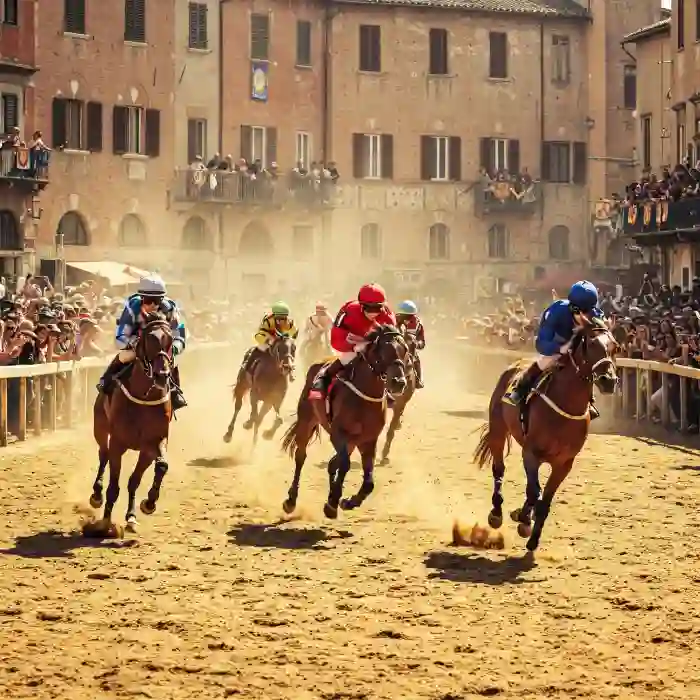
The decree on palio races and horse events (such as the “Palio di Siena”) by Italian Sports Minister Andrea Abodi, which would introduce “stricter measures to ensure the safety of jockeys and spectators, animal welfare, and the regularity of competitions,” is unacceptable. It clumsily defends alleged traditions that should instead be courageously abolished because they are anti-historical and based on the exploitation of animals for human entertainment.
ENPA, the oldest and largest Italian animal rights association, strongly condemns a measure that protects nothing (except the events themselves) because it is absolutely generic in its principles and, on the contrary, cancels the few, meager protections that exist for animals today. In particular, all control and verification responsibilities are entrusted to local health authorities and local police, effectively excluding those who – such as the Forestry Carabinieri – could only intervene in the presence of a concrete hypothesis of a crime, thus reducing the scope of control. Furthermore, the decree presents vague and generic principles that leave organizers wide margins of discretion and interpretation. The element of “tradition” is once again invoked (“The events referred to in Article 2, paragraph 1, are authorized by the competent authority, also taking into account local traditions, customs, and practices”). And it is precisely on traditions and so-called “local customs” that organizers of these events and animal welfare organizations have clashed over the years.
Another critical element is the simplification of authorization procedures for events.
In short, there is nothing “stricter” in the decree except for the rightful exclusion of jockeys convicted of animal crimes.
That the decree is biased in favor of the organizers of these events and to the detriment of animal welfare and the need to abolish these events forever and everywhere is demonstrated by the immediate reaction of the mayor of Siena, Nicoletta Fabio, who expressed “satisfaction with the decree.” “The history, traditions, and culture of the Palio have been acknowledged,” stated Fabio, who added: “As can be read in the text, reference is made, in particular, to local traditions, customs, and practices, as well as to the architectural conformation of the sites where the events take place.”
The Italian Animal Protection Agency (ENPA) has always opposed the Palio of Siena, which it considers a symbol of the exploitation of horses in events of this kind. Over the years, several horses have died in accidents during the Palio of Siena. For years, ENPA has also been opposing the recognition of the Palio as UNESCO Cultural Heritage.